
“Signs of Peace are signs of light, signs of hope in a moment when it’s easy to think there is no way to bring all of us together as one humanity.”
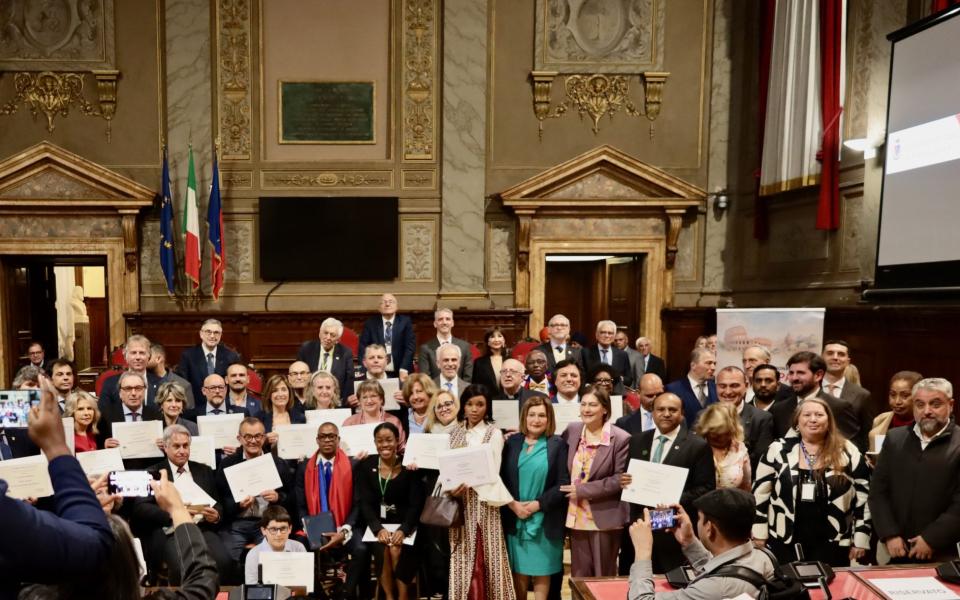
Those are Maria Eugenia Crespo’s own words, written after she returned from Rome, where she had just been recognized as an Official Ambassador of Premio Nazionale Segni di Pace at Italy’s National Signs of Peace Award held on 15 April 2026 in Rome.
But if you know Maria, you know she wasn’t just speaking for herself, she rarely does.
As URI’s Director of Growth, Learning, and Impact, she works with over 1,200 Cooperation Circles in 120 countries.
Through URI, she says, she has been “granted the opportunity to experience light and hope through the courage of many grassroots leaders who dare be signs of peace in the midst of fragmentation and violence because they care for others and believe they have a role to play to build a better place.”
The room was full of journalists, educators, peacemakers from across the world.
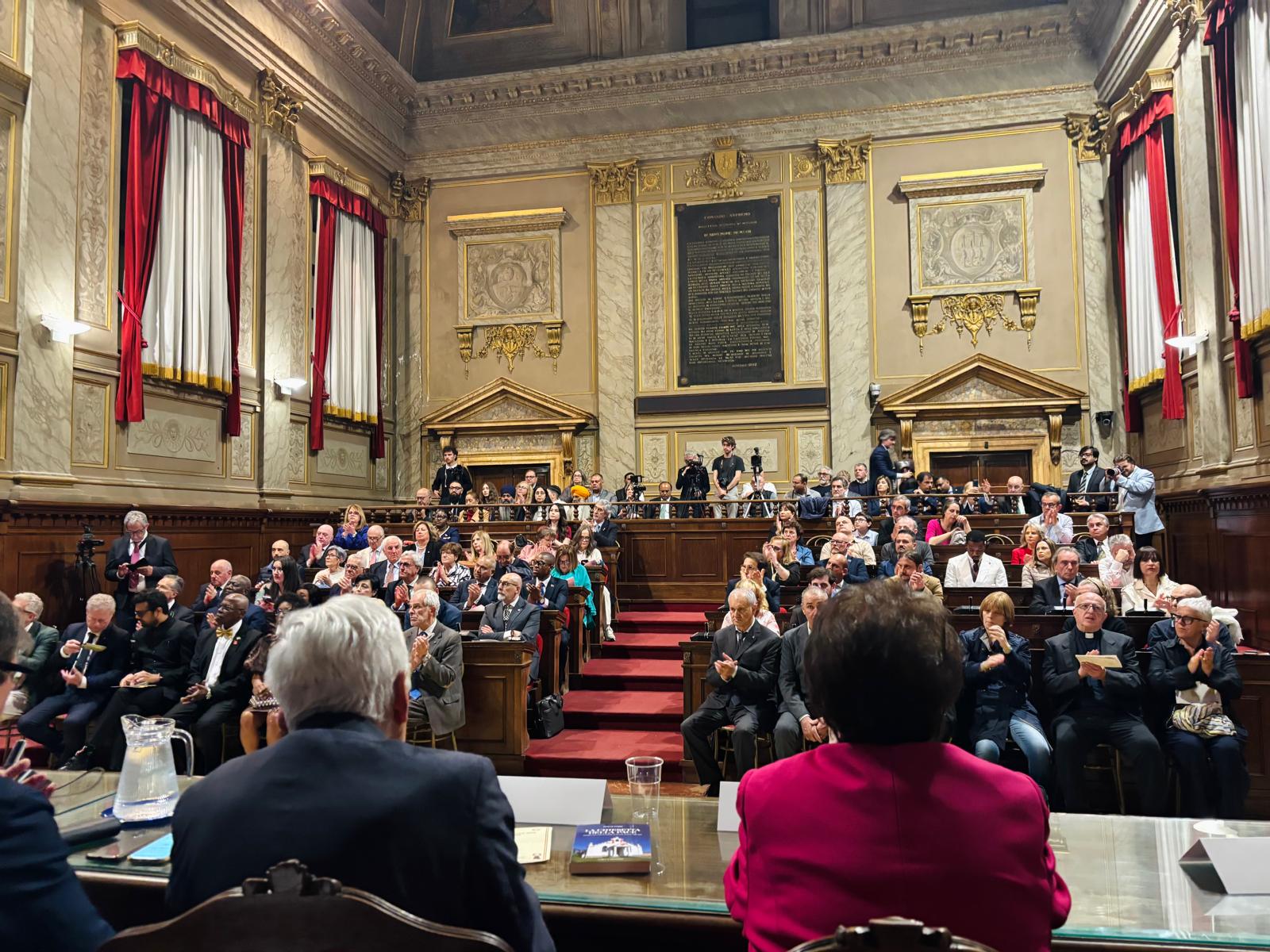
Italy’s award ceremony was underway, speaker after speaker had taken the stage, Maria reminded us about our current realities, a reality we are called to change, a reality marked by war, instability, pain and urgency but also a reality that spells hope. She addressed the audience and said;
“The war does a lot of noise and a lot of harm. But peace is usually silent, and we don’t always recognize those that bring peace.”
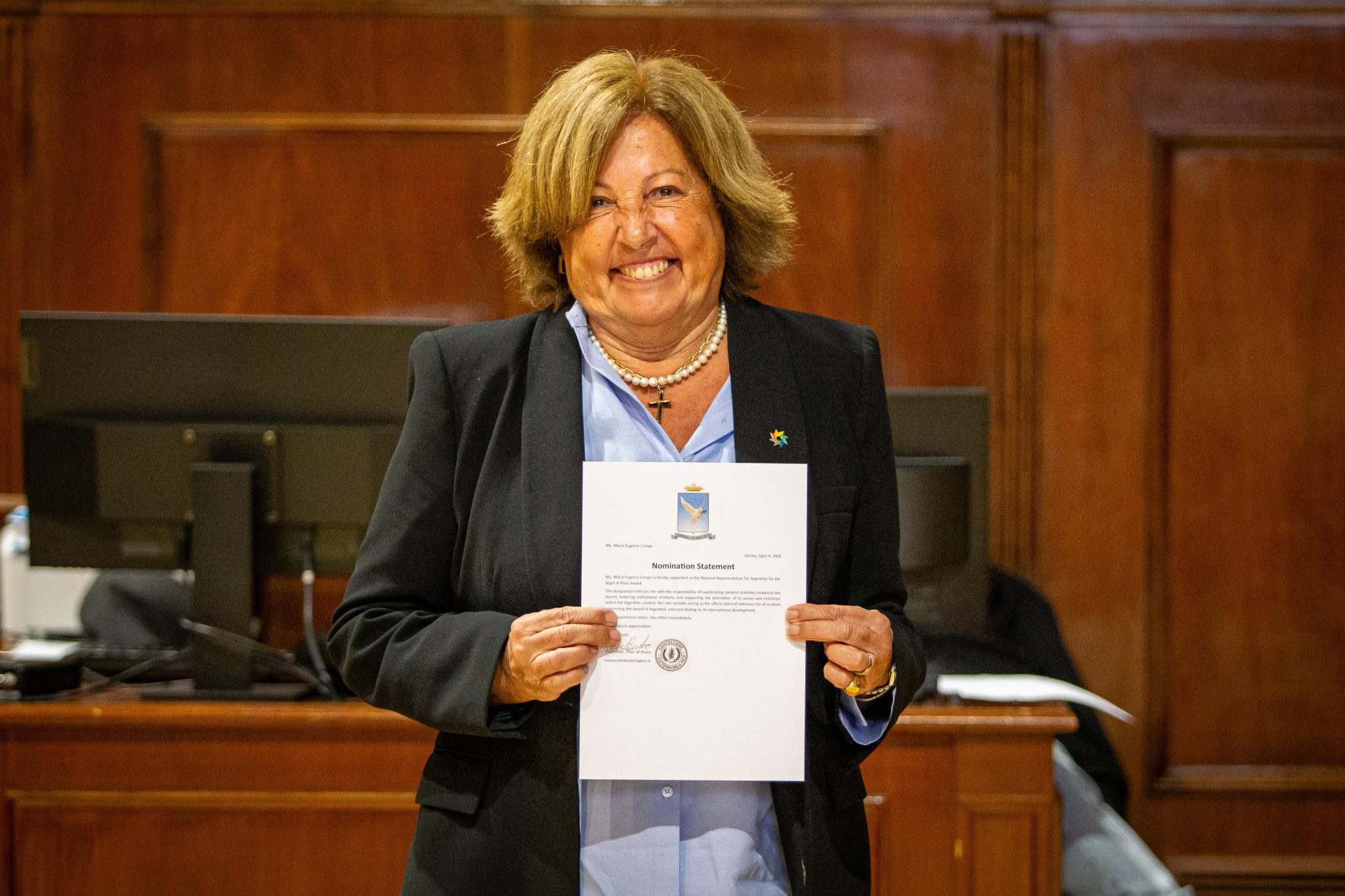
When the invitation arrived, Maria was surprised she was being recognized for the work URI has done. Then the letter explained something different: she was also being honored for what she could see. For her capacity to identify and spotlight signs of peace in Argentina and across the world.
“I had to adapt myself to the fact that I was invited to receive the award and then, no, we want to give you something that is more important, the possibility to spotlight signs of peace in Argentina and the world.
She was being named not only for what she had done, but for what she could see. As the only person in Argentina contacted to identify and spotlight signs of peace locally and internationally, her recognition was really a responsibility and she received it!
“It was a recognition that doesn’t necessarily recognize me, but the possibility to spotlight our amazing colleagues, co-workers, friends around the world.”
She was one of five people honored at the ceremony, alongside teams from Haiti, Pakistan, and Mali, and a young Italian author.
But before the award, there was a country,a past, a sister, and URI.
To understand why Maria does this work, you have to go back to Argentina in the 1970s, to a country shaking under the weight of revolution and dictatorship and to a young woman who was not innocent about violence,because violence had come to her door.
“As you may know, violence was very strong in Argentina in the 70s, there was all this revolution, dictatorship. So it’s not that I was innocent about peace because I had experienced violence very close at a personal level.”
One of her sisters had given her life to the revolution. She loved her and yet unfortunately lost her. But from this tragic event, came the commitment to contribute to peace, justice and healing by building bridges of understanding
“I thought there was another way. So URI is a way for me to build peace that is different from what she chose, or what we suffered.”
She was born in a Catholic family and has always been very involved in the Church. She found URI and URI found her and this has been a gift for Maria.
In Buenos Aires, she says, it is entirely possible to live your whole life without ever meeting someone of a different religion, spiritual expression, or indigenous tradition. She was coordinating groups, bringing people into the faith, doing work she loved.
Then URI came to Buenos Aires in 1997. And something cracked open.
“When I met URI, it was love at first sight.”
She is quick to add that not everyone felt that way. There was suspicion in Buenos Aires about an organization arriving with new ideas, new methodology like appreciative inquiry. Even within her own community, there was reluctance.
“But I was not afraid,” she says. “I felt this was something of the time, something that adds rather than compete with my spiritual path”
What URI gave her was not a reason to leave her faith. It was a window inside it.
“Finding the spiritual outside the Catholic church was breath-giving to me. It expanded so much in my heart. I could recognize the Holy Spirit through people of other faiths.”
“I continued to be very grounded in my own faith. URI didn’t take me away from it. It opened a window.”
As a volunteer in URI, She started going into schools especially those that are based on a particular religion like Catholic schools, Jewish schools, Muslim schools.
She visited with teams of young people and religious leaders, bringing diversity into spaces. She was opening the eyes of children earlier than her own eyes had been opened. She knew exactly what she was doing.
Today, we have witnessed the fruits planted years back, fruits that have been rooted in resilience from violence, from loss, positive encounter, intentionality and now, working with grassroots communities that has culminated into receiving the Premio Nazionale Segni di Pace.
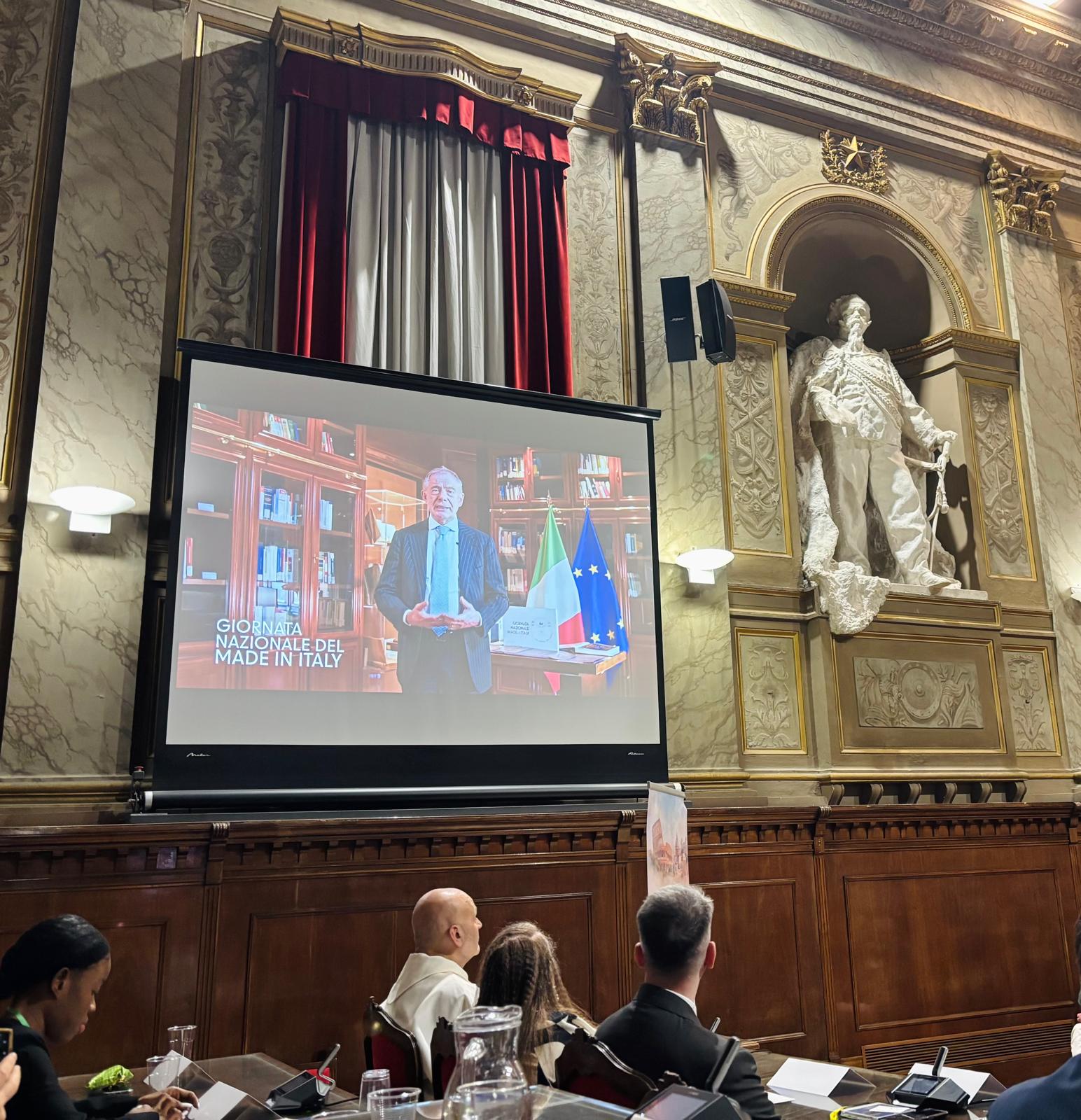
As URI’s Director of Growth, Learning and Impact , Maria works with over 1,200 Cooperation Circles across 120 countries and that evening in Rome, every single one of them was in the room with her, a realization that she didn't walk alone.
“Being named an Official Ambassador of the Sign of Peace Award was very moving,” she says. “But immediately I said, there are so many people around the world, signs of peace, that I have met and learned about on a daily basis. So yes, I was the one named. But at the same time I was coming with so many signs of peace in my mind and in my heart.”
She came to Rome, as Maria, and a summation of URI that includes over 1200 Cooperation Circles, Individual Members and friends of URI.
To close her remarks, she turned to Eduardo Galeano the South American writer who described humanity as a “sea of little fires,” each person shining with their own unique light.
It wasn’t just a literary flourish. It was how she came to understand her own journey.
“For me in Argentina, as a Catholic, understanding that I can bring change working with others has been crucial to become a sign of peace, building bridges of collaboration with those that are different. Only through understanding that we are stronger and most effective if we collaborate, we have found the way to create cultures of peace, justice, and healing.”
She believes this is the need of this exact moment. “Bridge-building is a need of the time when there is so much fragmentation and polarization.
Religions, spiritual expressions, and indigenous traditions are moved by values that inspire this. And this is what URI stands for.”
Reminiscing a conversation with Maria, one thing that we understand is that peace has a cost and she doesn’t romanticize it. She says,
“Being a sign of peace implies a deep commitment to choose what brings peace not only for you but for others. This requires attention to the signs of the times, to the signs of each and everyone around you, and deep care. We cannot pray or say we are building peace in the world if we are not coherent if we don’t build peace around us.”
And if you tell her you want to do what she does, she won’t hand you a brochure. She’ll say,
“Join me in opening your heart to be able to see what people around the world need, and let’s work together to help them find sustainable solutions. Each person counts and the more we can connect and build constructive relationships, the more peace, justice, and healing.”
And as we joyfully celebrate the Premio Nazionale Segni di Pace award, we are reminded of our collective commitment and role for a peaceful, just and healed world. And with that, we share Maria’s reminder to the world,
“Meet people where they are and offer your hand. Together we are stronger.”