
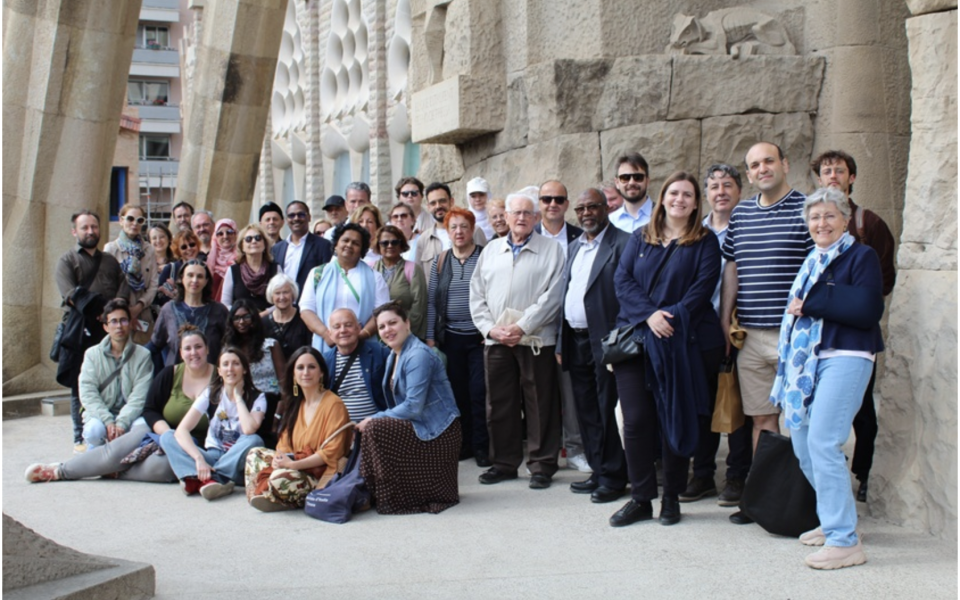
The URI Europe Assembly 2026, held in Barcelona under the theme “Sacred Earth, Shared Humanity: URI Europe Responses to Violence and Harm,” brought together nearly 50 interfaith leaders, Cooperation Circle representatives, youth changemakers, and peacebuilders from across Europe.
More than a conference, the Assembly was designed as a space for encounter, relationship-building, collective learning, and the strengthening of a shared commitment to peace, justice, and healing.
At a time marked by increasing polarization, religiously motivated violence, hate speech, ecological crises, and growing social fragmentation, the Assembly aimed to explore how interfaith cooperation can offer meaningful responses rooted in dialogue, solidarity, and shared humanity.
The gathering aligned closely with the URI Strategic Framework 2025–2030, particularly its focus on strengthening network vitality, building collaborative leadership, preventing violence, and promoting healing for both human and Earth communities.

Throughout the Assembly, participants engaged in dialogue sessions, storytelling circles, and workshops. They exchanged grassroots practices from different contexts and explored practical approaches to violence prevention, interfaith dialogue, youth leadership, and environmental restoration. Conversations highlighted the importance of moving beyond symbolic dialogue toward concrete cooperation and locally rooted action.
One of the strongest reflections emerging from the gathering was the need to rebuild trust and human connection in increasingly divided societies. Participants repeatedly emphasized that peacebuilding begins not only through institutions and policies, but through relationships, shared experiences, and the willingness to truly encounter one another across differences. The Assembly created space for those encounters to happen in meaningful and transformative ways.
Youth participation was another central aspect of the gathering. Young leaders were not only participants but facilitators, organizers, and contributors to key discussions. Their creativity, energy, and leadership reflected URI Europe’s commitment to intergenerational collaboration.

Environmental healing and Earth restoration also became deeply woven into the Assembly’s reflections. Participants explored how spiritual traditions, Indigenous wisdom, and local practices can help restore relationships with the Earth and strengthen collective responsibility for the future. These discussions reinforced the understanding that human healing and ecological healing are deeply interconnected.
A particularly meaningful public moment took place at Barcelona City Hall during the event “Sacred Earth, Shared Humanity: Pathways to Peace in Times of Harm,” where participants engaged with civic leaders and local partners. The Assembly also included visits to important spiritual and cultural spaces in Barcelona, including the Sagrada Família, where reflections centered on hope, shared humanity, and the importance of “walking together” in difficult times.

Beyond the sessions themselves, one of the Assembly’s most important achievements was strengthening the sense of belonging within the URI Europe network. Participants left not only with new ideas and project possibilities, but with renewed relationships, deeper trust, and a shared sense of responsibility to continue building cultures of peace and cooperation in their own communities.

The success of the Assembly was made possible through the generous partnership and hospitality of AUDIR CC (Associació UNESCO per al Diàleg Interreligiós i Interconviccional), whose team played a vital role in hosting and supporting the gathering in Barcelona.
Participants had the opportunity to learn more about AUDIR’s longstanding work in promoting interreligious and intercultural dialogue, social cohesion, and peaceful coexistence in Catalonia and beyond. Their commitment to building bridges across communities provided a powerful example of local interfaith action and enriched the Assembly experience through meaningful collaboration, local engagement, and shared learning.
The Assembly concluded with a simple but powerful reflection: peace, like planting a tree, requires patience, care, and long-term commitment. The conversations and connections initiated in Barcelona are intended not to end with the gathering itself, but to continue growing through future collaborations, grassroots initiatives, and shared action across Europe and beyond.