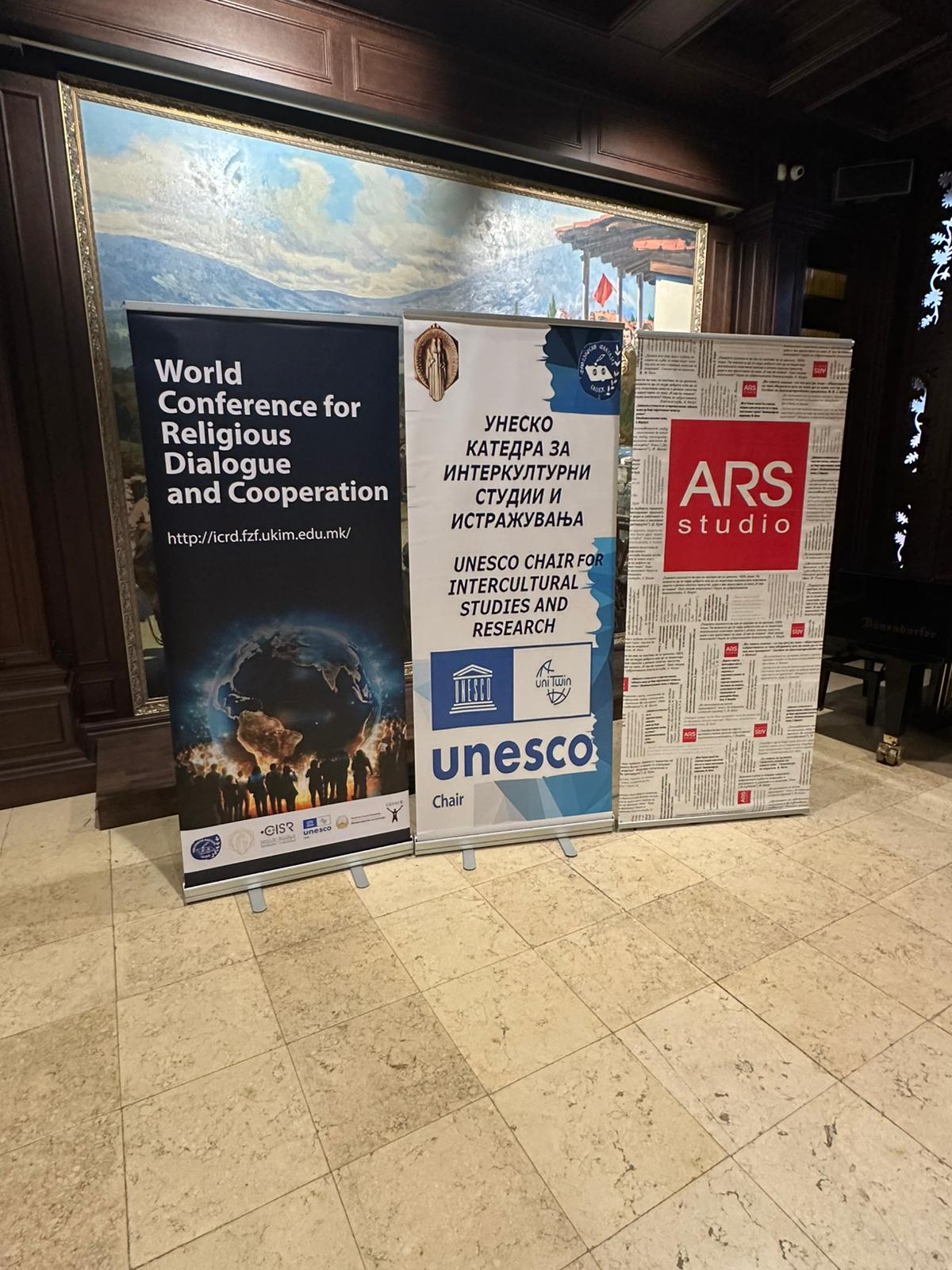

At the 4th World Conference for Religious Dialogue and Cooperation, held in Skopje, North Macedonia, from 22 to 26 June 2026, religious scholars, practitioners, and civil society leaders gathered to reflect on the conference theme, “Religion as a Weapon of War: in the past, present and future.”
The event was organized in partnership with the UNESCO Chair in Intercultural Studies and Research and the Center for Intercultural Studies and Research at the Faculty of Philosophy in Skopje.
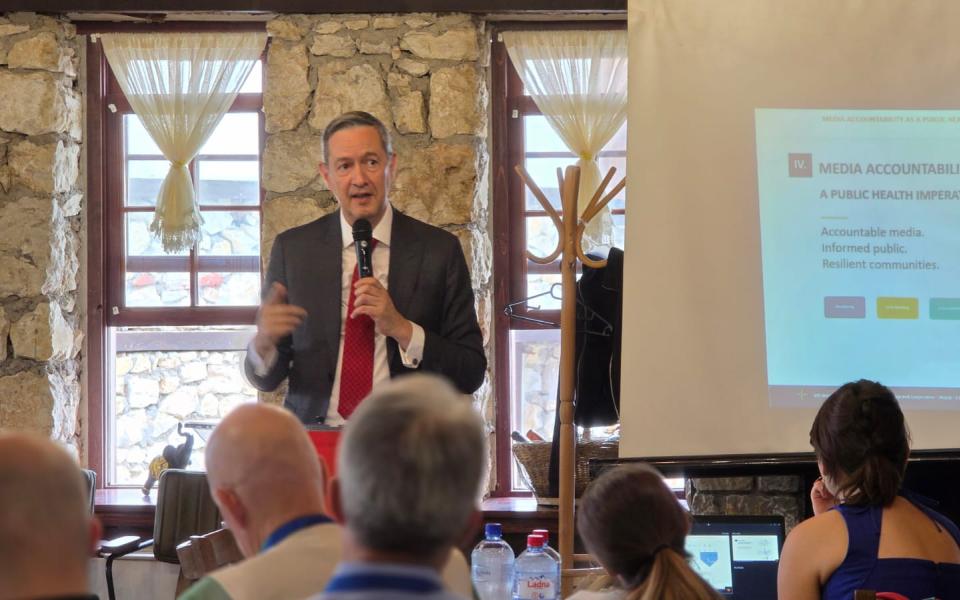
Eric Roux, Chair of the Global Council of United Religions Initiative, was invited to address the conference on a subject that lies at the heart of URI’s mission: how societies can prevent violence against religious minorities before it begins.
His presentation, titled “Media Accountability as a Public Health Imperative in Preventing Violence Against Religious Minorities,” proposed a shift in the way we understand violence. Rather than seeing violence only as a legal problem, a moral failure, or a geopolitical consequence, Roux invited participants to consider violence through a public health lens.
This approach, first advanced by the World Health Organization and later developed by researchers such as Dr. Gary Slutkin, treats violence as a phenomenon that spreads through social environments, patterns of exposure, and shared narratives.
The central argument was simple but urgent: violence against religious minorities rarely begins with physical attacks. It often begins earlier, in the language, images, and narratives that make certain communities appear dangerous, foreign, irrational, or less than fully human.
Media stigmatization, in this perspective, is not merely a matter of bad journalism or unfair representation. It can become a precursor to real-world harm. When a religious minority is repeatedly portrayed as a threat to society, the public may become less sensitive to its exclusion, discrimination, or persecution. Over time, the moral barrier that normally protects human beings from violence can weaken.
The public health model of violence prevention offers three key principles: interrupt transmission, identify those most at risk, and change community norms. Applied to religious violence, this means that societies must pay attention not only to acts of violence themselves, but also to the narratives that prepare the ground for them.
Roux emphasized that “othering” is often the incubation period of violence. A group is first simplified, then stigmatized, then treated as a danger. Once this process becomes normalized, aggression against that group can begin to seem acceptable, or even necessary, to some parts of society.
The presentation pointed to historical and contemporary examples. Nazi propaganda against Jews, including the role of Der Stürmer, remains one of the clearest warnings of what sustained dehumanization can produce. In Iran, state-backed demonization of the Baha’i community has long contributed to social hostility and persecution.
In India, conspiracy narratives such as “Love Jihad” and campaigns around cow vigilantism have helped create conditions in which Muslim and Christian minorities may be targeted. Other examples show that even in democratic societies, sensationalist portrayals of minority religions can contribute to climates of hostility and suspicion.
For URI, this issue is not abstract. Around the world, Cooperation Circles work daily to build trust across religious, spiritual, and cultural differences. That work becomes harder when media narratives push communities into fear, suspicion, or resentment. Dialogue cannot flourish where entire communities are constantly depicted as threats.
The call made in Skopje was therefore not a call for censorship. It was a call for accountability.
Media freedom is essential. But freedom also carries responsibility, especially when public narratives concern vulnerable communities. Journalists, editors, producers, commentators, and platforms all have a role in preventing the spread of language that dehumanizes believers or turns religious identity into a marker of danger.
Roux proposed that media accountability should become part of violence prevention. Civil society organizations, academic institutions, intergovernmental bodies, and faith-based networks can help monitor patterns of stigmatization and dehumanization.
Such monitoring can serve as an early warning system, identifying harmful narratives before they contribute to social exclusion, mob violence, or state repression.
This approach would also strengthen freedom of religion or belief. Protecting religious minorities is not only about responding after attacks occur.
It is also about recognizing the warning signs that appear before violence becomes visible. In many cases, those warning signs appear first in words, headlines, images, documentaries, broadcasts, and online campaigns.
The message delivered in Skopje resonates strongly with URI’s founding vision: to promote enduring, daily interfaith cooperation, to end religiously motivated violence, and to create cultures of peace, justice, and healing. If violence can spread through narratives, then peace can also spread through narratives.
Responsible media can humanize where others dehumanize. It can create understanding where others create fear. It can help societies see religious minorities not as problems to be managed, but as communities of human beings with dignity, history, and rights.
The challenge now is to move media accountability from the margins of public debate to the center of violence prevention. Dialogue, education, and cooperation remain essential. But they must be accompanied by a clear awareness that the words used about religious communities can either protect life or endanger it.
In Skopje, URI’s message was clear: preventing violence requires more than condemning attacks after they happen. It requires courage to identify the narratives that make those attacks possible, and the commitment to interrupt them before they spread.